If you've been watching Santa Cruz listings from a distance, the condo market probably looks like the reasonable move. Houses are still stubbornly expensive. Condos are cheaper, and cheaper is supposed to mean safer in a cooling market, since that segment usually draws steady demand from downsizers and first-time buyers who need a lower entry point no matter what rates are doing.
The county's own numbers from this month tell a different story. As of September 5, 2026, the median condo sale price in Santa Cruz County was down 9.1 percent year over year, while the median single-family price was down only 4.6 percent over the same stretch. Condo sales volume fell 17.2 percent year over year, and condo inventory shrank 16.7 percent at the same time. Only 100 condos were on the market countywide that day, against 342 single-family homes.
That combination should bother you if you're the kind of buyer who reads the fine print. When inventory shrinks, price is supposed to firm up. Less to choose from usually means sellers hold their ground. Here, supply and price fell together, which means something is actively pushing buyers away from condos rather than simply a glut of listings sitting unsold. The gap between the median condo price (down 9.1 percent) and the average condo price (up 1.9 percent) points at what that something is: a widening split between condos that still trade close to their value and a specific slice of the stock that buyers are avoiding.
The single most current data point, side by side
| Single-family (through Aug 2026, YoY) | Condos (through Aug 2026, YoY) | |
|---|---|---|
| Median sale price | Down 4.6% | Down 9.1% |
| Average sale price | Down 8.5% | Up 1.9% |
| Sales volume | Fewer sales | Down 17.2% |
| Active inventory | Down 9.3% | Down 16.7% |
| Homes/units for sale (as of Sept 5) | 342 | 100 |
Look at that median-versus-average split again. If both numbers were falling together, you'd read it as a broad correction. They're not. Median down, average up, in the same market, in the same month, tells you the low end of the condo stock is getting hit hardest while a smaller group of higher-value units keeps its footing. That's not a market-wide story. That's a building-by-building story.
Why 2026 is different for a Santa Cruz condo
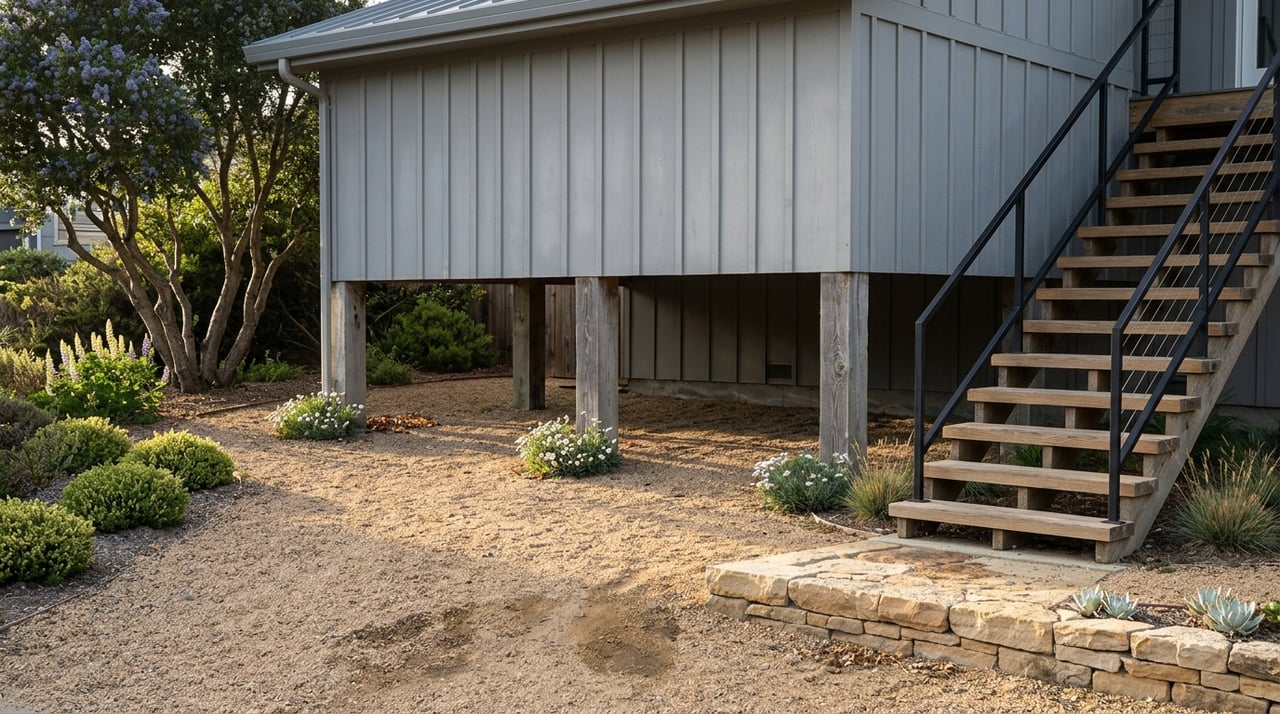
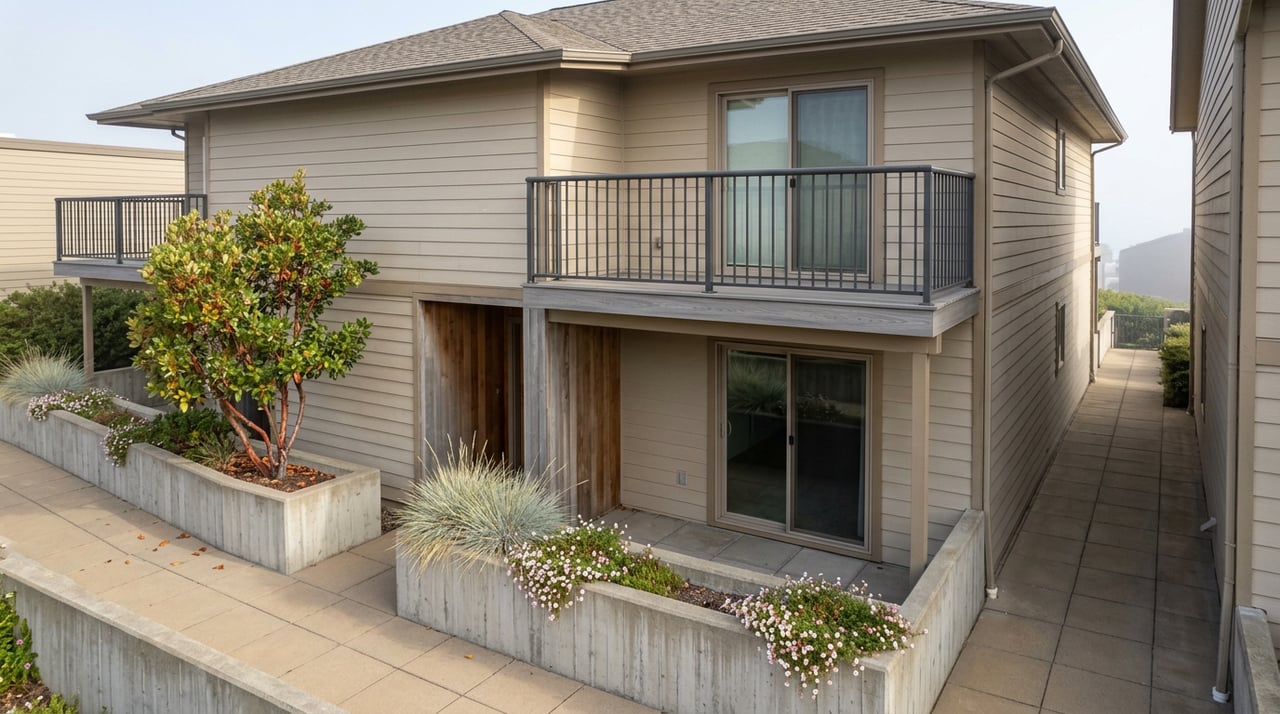
California's SB 326 set a January 1, 2026 deadline for condo associations with three or more units to complete inspections of every exterior elevated element on the property, which the law defines as balconies, decks, walkways, and load-bearing structural components more than six feet above the ground. Associations that come back with deferred maintenance don't get a grace period to quietly fix things on their own schedule. They face enforcement fines, insurance coverage gaps, and personal liability exposure for board members if they sit on the results.
Santa Cruz's condo stock is a near-perfect match for what this law is designed to catch. Complexes like Pacific Terrace Condominiums, built around 1980 on the stretch between Soquel and Broadway avenues, were built with exactly the kind of elevated wood-framed decks and walkways SB 326 targets, on a gated, elevator-served hillside site where those elements have had four and a half decades of coastal weather to work on them. Compare that to something like 2030 N. Pacific, a downtown complex completed in 2008 on the old George Wilson Sheet Metal site. Newer concrete-and-steel construction of that vintage simply hasn't had the same runway for deferred maintenance to accumulate, and it's a much smaller inspection risk this year.
The dollar figures behind a failed inspection are not abstract. Recent California cases have produced special assessments running $40,000 to $60,000 per unit at communities dealing with the combination of an aging structure and a law that no longer lets a board defer the bill. Nationally, HOA data tracked by the community-management platform Vantaca shows regular monthly assessments have risen 50.5 percent since 2020, more than double the pace of inflation, with the median special assessment reaching $1,100 per unit in 2025 and nearly 1 in 10 HOAs levying one that year. None of that is unique to Santa Cruz, but Santa Cruz's inventory skews toward exactly the building age where it lands hardest.
The second mechanism, and the one buyers overlook
There's a financing wrinkle that makes this worse, and it has nothing to do with your own credit or down payment. FHA and many conventional lenders don't approve condo purchases unit by unit. They approve the entire building. The HOA has to submit financials, owner-occupancy data, insurance coverage, and litigation history to the lender or to HUD, and that approval typically runs on a multi-year renewal cycle managed by the HOA, not the buyer.
A building that carried FHA approval three years ago can lose it without any public announcement if reserves have dropped, if a lawsuit has surfaced, or if insurance coverage has lapsed. The buyer who wants that specific unit finds out only when their loan officer tells them the project isn't on the approved list. If the building can't clear that bar, the pool of buyers who can even bid on a unit there shrinks, sometimes to cash buyers and conventional-loan borrowers only. That's a second reason a specific complex's median price can slide even while the county's overall housing market holds steadier ground: fewer people are eligible to buy there, whatever they're willing to pay.
What to actually ask for before you write an offer
None of this means avoid Santa Cruz condos. It means the diligence has to happen at the building level, not the county level. Under California's Davis-Stirling Act, an association has to produce the following for a prospective buyer within a set window of a written request, and you should ask for it before you're emotionally attached to a unit, not during a tight escrow contingency period.
- The HOA's current reserve study, including the percentage funded and any components flagged for near-term replacement
- A copy of the master insurance policy, including whether it covers the building on a walls-in, all-in, or bare-walls basis
- Written confirmation of the building's SB 326 elevated-element inspection status, including the report date and any deficiencies noted
- Minutes from the last two board meetings, specifically looking for any discussion of a pending or proposed special assessment
- Disclosure of any pending or threatened litigation involving the association
- Confirmation of the building's current FHA or conventional project-approval status if you're financing rather than paying cash
If a board is slow to produce these, or the answers are vague, treat that as information in itself. A well-run association with healthy reserves and a clean inspection has every reason to hand this over promptly.
What this means if you're comparing a condo to a house right now
The county-level median is telling you condos are cheaper than they were a year ago. It is not telling you why, and the why is doing all the work. Some of that discount reflects real risk sitting inside specific HOAs, tied to a law that took full effect this year on buildings of a particular age. Some of it reflects a shrinking buyer pool at buildings that have quietly lost financing eligibility. Neither of those things shows up in a portal search filtered by price and bedroom count.
That's also why a single-family purchase in the same neighborhood behaves differently. A house doesn't come with a master policy, a shared reserve fund, or a board vote standing between you and your own equity. The math is more self-contained, which is part of why single-family prices have held closer to flat while condo prices have moved more sharply in both directions depending on the building.
A few questions worth asking before you go further
Does this mean I shouldn't buy a Santa Cruz condo right now? No. It means the building's paperwork matters more than the county median. A newer complex or a well-reserved older one can still be a sound purchase. The risk sits in specific buildings, not in the category.
How do I find out if a specific complex has completed its SB 326 inspection? Ask the HOA board or management company directly and request the written report. If you're working with an agent, this should be one of the first documents requested once you're in contract discussions, not something left until the inspection period.
What if the HOA won't provide the documents I'm asking for? Under the Davis-Stirling Act, associations are required to produce governing documents, financial statements, reserve studies, and litigation disclosures to a prospective purchaser within a defined window of a written request. Slow or incomplete responses are worth treating as a caution sign rather than a formality to wait out.
If you're weighing a condo against a house in Santa Cruz, or you already own one and want a clear read on what your building's financials actually say about resale, I'd rather walk through the specifics with you than let a countywide median make the call. Caroll Basile offers a free home valuation and a plain-language look at what a building's paperwork means for your timeline, whether you're buying into Santa Cruz or getting ready to sell out of it.